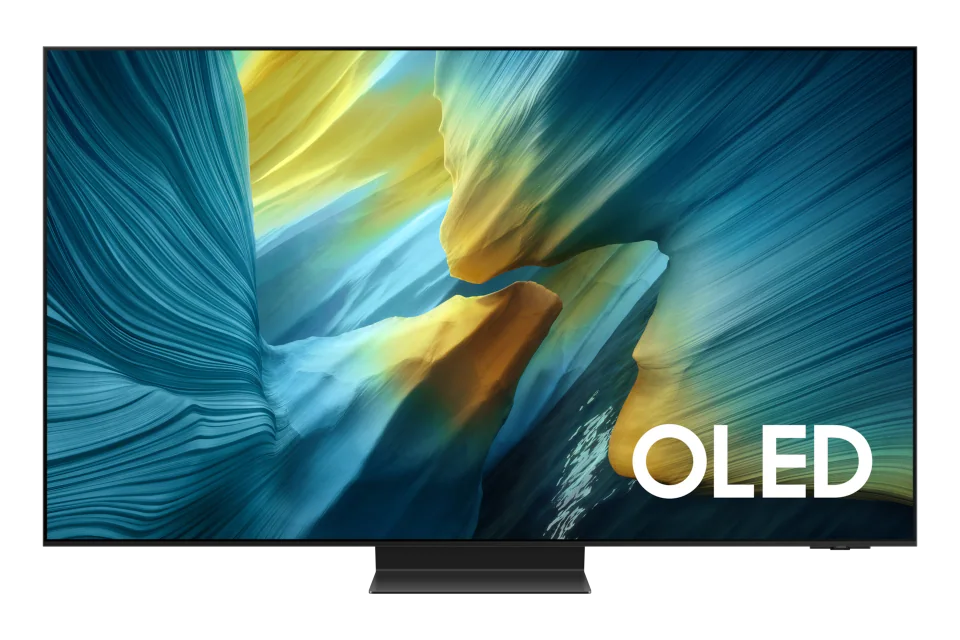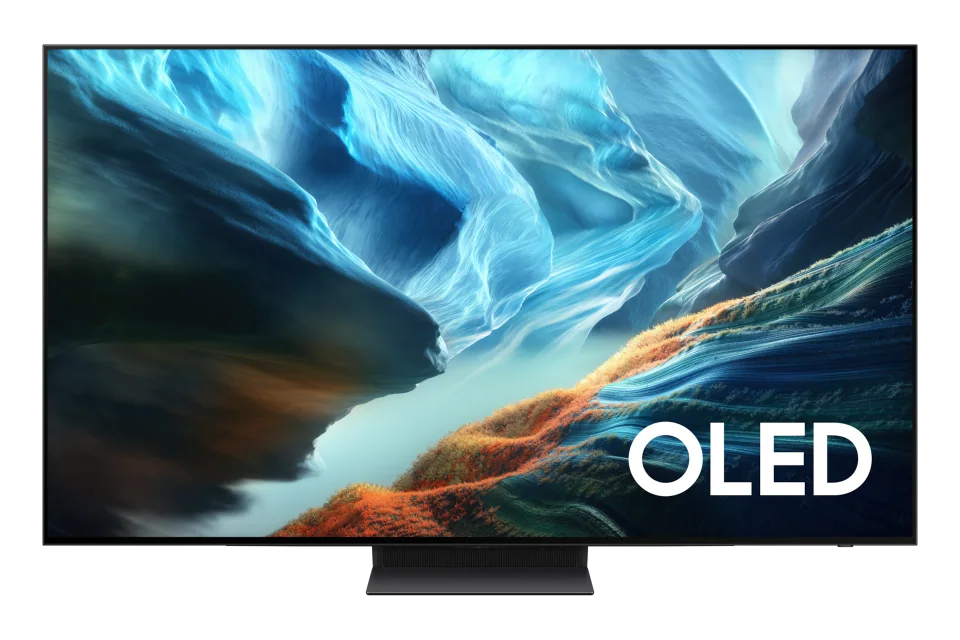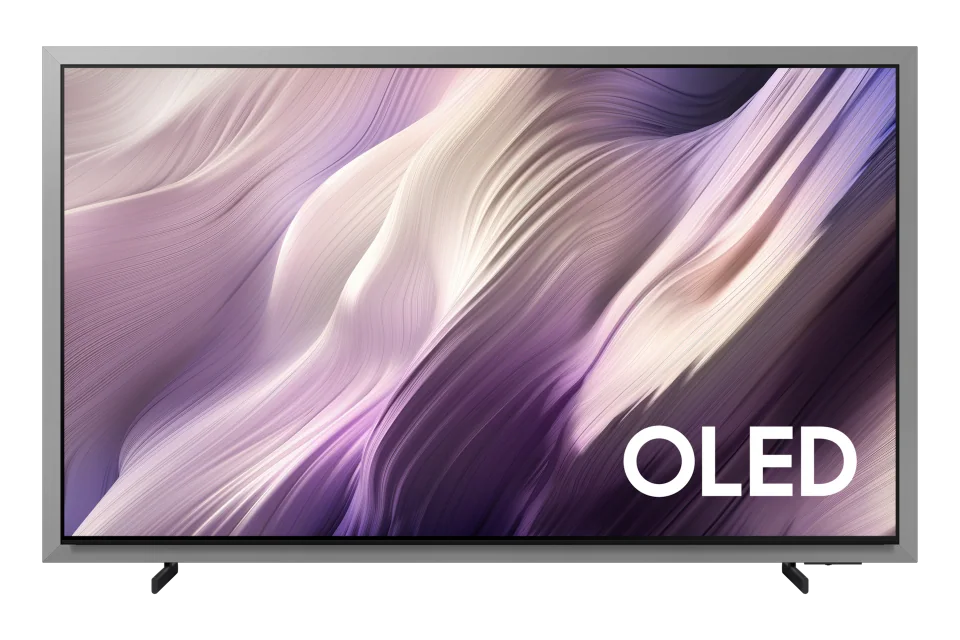
Samsung · 2026 · QD-OLED
S95H OLED
55 · 65 · 77 · 83″
From
$1,900
MOV
BRT
GME
Explainer
QD-OLED swaps the color filters in a standard OLED for a quantum dot layer. Here is what that changes, and what it costs.
QD-OLED stands for quantum dot organic light-emitting diode. It is a way of building an OLED TV that aims to get more brightness and purer color out of the same basic idea: pixels that make their own light and can switch fully off.
Most OLED TVs, including LG's, are called WOLED, where the W stands for white. Tom's Guide explains that these panels create white light and then pass it through red, green and blue color filters, with an extra white subpixel to help with brightness. Filters absorb light, so part of the light is lost, and that limits both brightness and the range of colors the screen can reach.
A QD-OLED panel starts with blue OLED light. A layer of quantum dots, which are microscopic semiconductor particles that glow in very pure colors when light hits them, converts some of the blue into red and green. Because no color filters are needed, less light is wasted. TechRadar notes this also lowers power consumption compared with filter-based OLED.
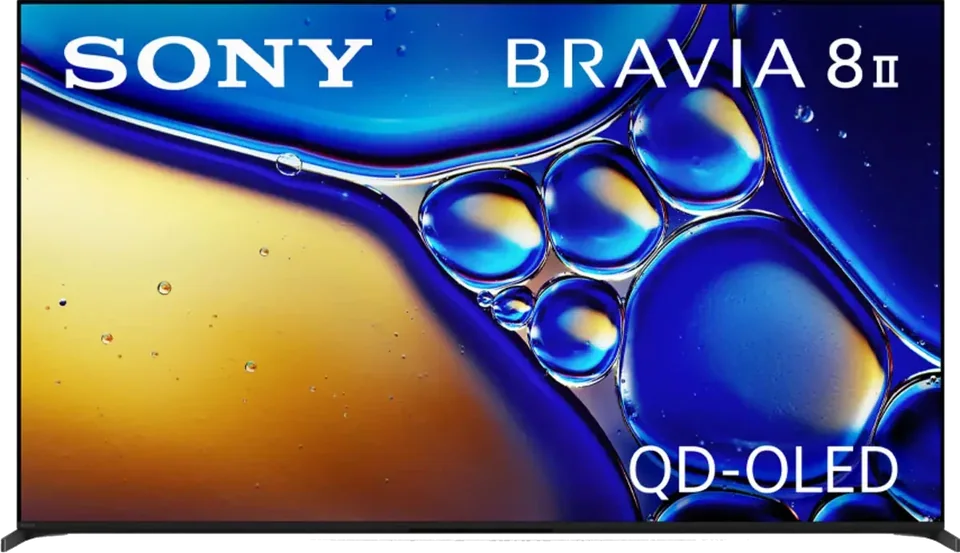
Samsung Display makes QD-OLED panels for TVs. Tom's Guide reports that the technology debuted in 2022 on the Samsung S95B, and that Samsung and Sony are the two brands selling QD-OLED TVs, while LG sells WOLED and its own tandem designs. Tom's Guide lists the Samsung S95F and Sony's Bravia 8 II as QD-OLED sets, and its newer coverage treats the Samsung S95H the same way.
Both outlets describe the same pattern.
There are also small quirks. Tom's Guide's tester points out that the triangular subpixel layout in QD-OLED can produce faint green and magenta fringes along high-contrast edges, which is only likely to be noticeable if you sit very close or use the TV as a computer monitor. It is not a concern for ordinary TV viewing.
LG has not made QD-OLED. Instead, LG Display developed Primary RGB Tandem OLED, sometimes called four-stack OLED, which replaces the filters with layers that emit red, green and blue directly. Tom's Guide says lab tests show these panels can produce brighter highlights than standard WOLED, and in some cases brighter than some QD-OLEDs. However, the same publication found the best QD-OLEDs still make more vivid color, so the Samsung S95H-class sets are ahead on color while the LG G6 is notable for white highlight brightness.
Yes. TechRadar says QD-OLED remains prone to burn-in like other OLED types, and pixel shifting and similar protections reduce the risk. Our burn-in explainer lists practical habits.
If your room is dim and you value color intensity, a QD-OLED is a strong choice. If your budget is tighter, a mid-range WOLED can still deliver the core OLED benefits of perfect blacks and wide viewing angles, and for very bright rooms a Mini LED may serve you better. For that decision, see OLED vs. Mini LED.
Good to know
Quantum dot organic light-emitting diode. It combines an OLED light source with a layer of quantum dots that convert the light into pure red and green.
On average it is brighter and more colorful than standard WOLED panels, but it usually costs more and not every brand offers it. Mid-range WOLED sets can still be an excellent value.
Yes. It is an OLED technology, so the same precautions apply: avoid leaving static images on screen for very long stretches and use the TV's built-in protection features.
Mentioned in this article
4 sources used for this article. We paraphrase and link, we do not republish.
More explainer
A nit is a unit of brightness. Here is how to read the numbers in TV reviews and how much you really need.

HDR widens the range between dark and bright on screen. Here is how the main formats differ and which brands support which.
What HDMI 2.1 actually adds, why only some ports on a TV may support it, and how to pick a cable that will not hold you back.
A short letter when something is worth your attention. Unsubscribe any time.